
Tongaat Hulett’s origins trace back to 1860, when the first Indian indentured labourers arrived in Natal. Individuals such as Madari Beeharie, a wagon man on the Tongaat Sugar Estate, were among those who cleared land and cultivated the cane fields that would eventually anchor a major agricultural and industrial enterprise.
Over more than a century, the company evolved into a cornerstone of regional economies, supporting towns, supply chains, and thousands of livelihoods across KwaZulu-Natal and beyond.
That legacy makes the present moment particularly sobering.
A Corporate Institution at a Crossroad
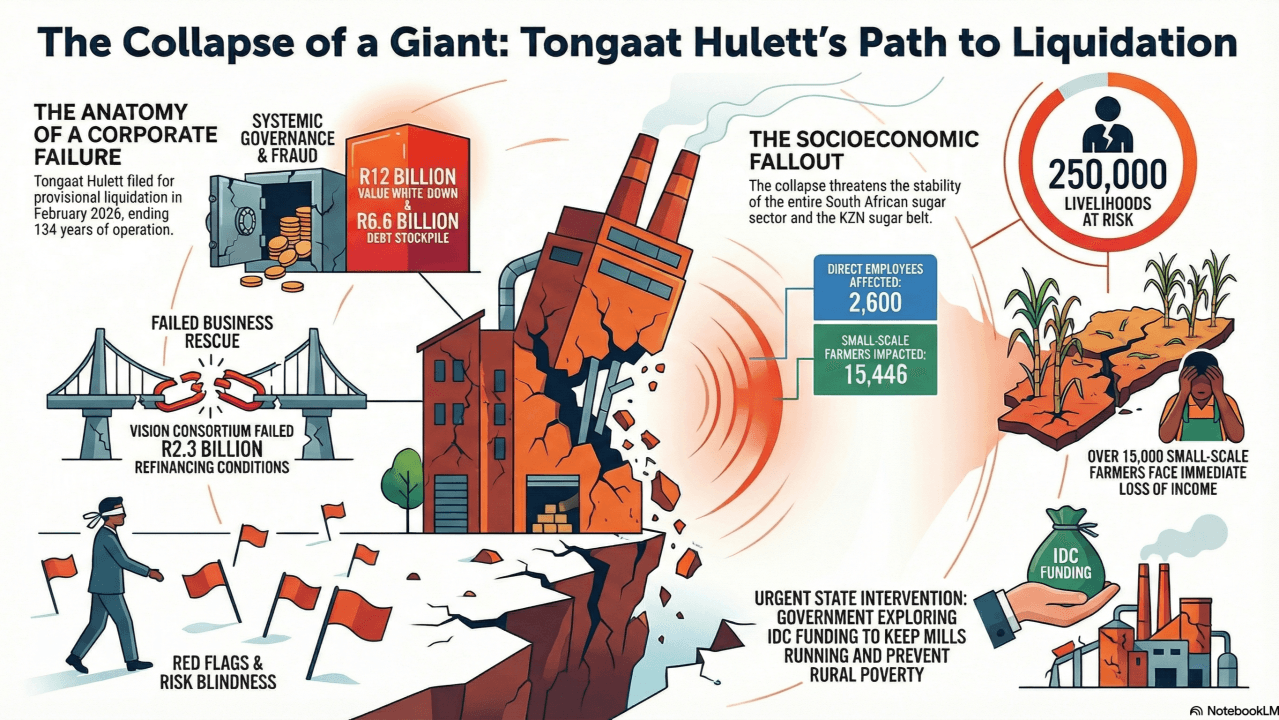
By early 2026, following the exhaustion of business rescue efforts, business rescue practitioners filed for provisional liquidation. The journey to this point has been long and complex.
The initial accounting irregularities uncovered in 2019 triggered a significant financial restatement, including a multi-billion-rand write-down. Over time, liquidity pressures, refinancing challenges, and operational headwinds compounded the strain. External factors including competitive import pressures and structural industry challenges added to the difficulty.
However, the crisis ultimately underscores something deeper than market dynamics.
A Governance, Risk and Compliance Perspective
The Tongaat experience provides a case study in the practical consequences of weakened Governance, Risk and Compliance (GRC) systems.
In retrospect, several systemic vulnerabilities became apparent:
- Internal control limitations allowed financial misstatements to persist over time.
- Risk oversight structures did not fully translate emerging warning signals into decisive intervention.
- Board supervision faced the challenge of responding to increasingly complex financial realities under pressure.
While hindsight is always clearer than real-time decision-making, the sequence of events illustrates how governance strain, if left unresolved, can escalate into existential risk.
Recognising the Early Warning Indicators
A review of the public record highlights themes that are instructive for boards and executives across industries:
- Earnings quality concerns where reported profitability did not fully align with underlying cash generation.
- Revenue recognition and asset valuation complexities, later identified through forensic review.
- Audit trigger delays, particularly in areas involving land and agricultural asset transactions.
- Concentration risk in recovery planning, with significant reliance on specific refinancing arrangements during business rescue.
None of these issues are unique to one company. They are governance pressure points common to many large, asset-heavy organisations operating in volatile sectors.
What This Means for Modern Boards
The lessons extend far beyond a single institution.
1. Independent Governance Assurance
Periodic external governance reviews, separate from statutory audits, can provide boards with a clearer, unfiltered assessment of control maturity and cultural risk indicators.
2. Escalation Architecture
Effective whistleblowing channels and protected reporting pathways are not compliance formalities; they are strategic safeguards. Escalation systems must ensure that emerging risks reach decision-makers early and without dilution.
3. Stress-Testing Recovery Scenarios
Business rescue and refinancing strategies require scenario modelling that anticipates execution risk. Diversified contingency planning is not pessimism; it is prudence.
4. GRC as Strategic Infrastructure
Governance is not administrative overhead. It is structural resilience. In capital-intensive sectors with extended value chains, governance robustness directly correlates with stakeholder protection.
The Multiplier Effect of Institutional Failure
Large enterprises anchor ecosystems. In Tongaat’s case, the broader value chain includes tens of thousands of small-scale farmers and up to a million people whose livelihoods intersect with the business.
When governance weakens in a dominant industry participant, the impact reverberates beyond shareholders. It touches suppliers, rural economies, financial institutions, and communities.
This is why governance is inseparable from economic stability.
ESG in Practice, Not Principle
Environmental, Social and Governance frameworks have become mainstream in corporate reporting. Yet events such as this illustrate that ESG must move beyond disclosure into operational integration.
True ESG maturity requires:
- Transparent earnings integrity.
- Embedded risk discipline.
- Protection of dependent stakeholder ecosystems.
- Long-term capital stewardship.
Without strong governance at the core, ESG becomes descriptive rather than protective.
A Broader Reflection
As the courts consider the company’s future, the human dimension remains central. Behind every balance sheet are employees, growers, service providers and families.
The Tongaat chapter should not be viewed solely as a story of failure. It should be treated as a governance inflection point for corporate South Africa.
Sustainable institutions are not defined by their scale or longevity, but by the strength of the systems that support them.
In volatile economic environments, governance is not merely compliance. It is continuity.